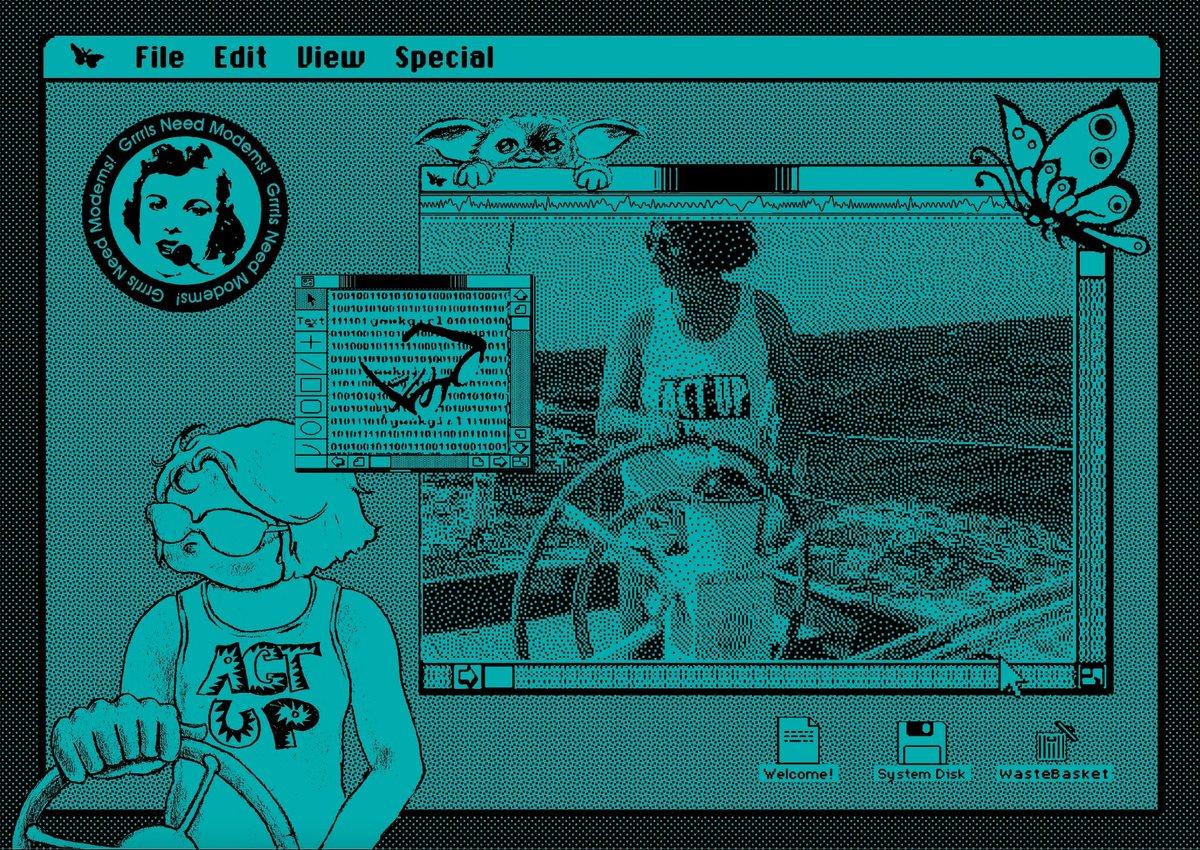
Image of the poster for the Bétonpapier n°12, illustration by árbol for Bétonsalon – Centre for Art and Research, Paris, 2026.


Image of the poster for the Bétonpapier n°12, illustration by árbol for Bétonsalon – Centre for Art and Research, Paris, 2026.


With AFALFL, Chadoh and Pérégrine
Workshop and concerts of live coding
A sound program curated with Manon Barbe, Vincent Enjalbert, Elena Lespes Muñoz
As part of Festival des fiertés des fiertés des 12e, 13e et 14e arrondissements
As part of the exhibition “MAGNANRAMA”, dedicated to Nathalie Magnan (1956–2016), a “dyke of technologies and internets,”¹ and the Pride Festival of the 12th, 13th and 14th arrondissements, a special event will focus on live coding, an artistic practice that involves coding in real time to generate sound and/or image.
“Live coding is an improvisational practice in which programming languages become instruments for real-time creation. During their performance, live coders write and modify code, projecting it so that the audience can follow their creative process. This transparency turns programming into an open, shared, and visible form of artistic expression. The practice sits at the intersection of computer music, software engineering, improvisation, and algorithmic or generative music. (…) By turning the computer into an instrument, live coding offers an interesting counterpoint to the usual landscape (…) of contemporary instrument-making.”²
Far from being neutral, technologies shape our imaginations and ways of acting. By bypassing ready-made music applications and manipulating code at its source, live coding invites us to develop a critical perspective on our relationship with computing—too often seen as merely utilitarian, or at worst as complicated and oppressive. By using the computer as an instrument, live coders divert a tool designed for work and commerce away from its intended functions. As North American computer musician, programmer, and live coding pioneer Renick Bell points out, “it would be much better if we had more control, if we could be the mediators of our own lives with our own algorithms, rather than being slaves to commercial algorithms.”³ Live coding thus emerges as a space for activism, advocating the free exchange of ideas and knowledge.
Heirs to hacker culture and the philosophies of free and open-source software, live coders fully embrace the creative and critical uses of machines championed by Nathalie Magnan, creating moments of exploration and conversation with both the machine and the audience. This event carries forward Magnan’s desire to make practices of technological appropriation living and contagious, extending her legacy: producing one’s own representations, bringing together LGBTQIA+ struggles and machines, and making code a tool for expression, resistance, and celebration.
The “Code Lovers” program features two live coding performances combining visuals and sound, at the crossroads of generative art and experimental electronic music. Pérégrine on visuals and AFALFL on sound bring their respective worlds together in a dialogue between real-time visual creations, powerful basslines, and free improvisation. Chadoh, meanwhile, takes us on a journey through ambient textures and energetic kicks, where celebration meets experimentation.
¹ Mathilde Belouali, in J’ai rencontré Nathalie Magnan (1956–2016), portrait en réseaux, 2026, published by Villa Arson, with the participation of Bétonsalon and the Les Capucins Contemporary Art Centre, Ville d’Embrun.
² Definition taken from the livecoding.fr website, dedicated to promoting the practice of live coding in France.
³ From the episode “Algorave: la teuf en open source?” of Arte Tracks, 2025.
AFALFL
Born in Mauritania and based in Paris, Mamady Diarra is a former DJ, now a musician and live coder.After studying Social and Human Sciences, he decided to focus on his passion for music and digital arts.Currently CTO at the Internet of Dead Things Institute (Iodt), Mamady also teaches at No School Nevers.-AFALFL found himself attracted to the experimental, underground Parisian electronic music scene. The producer and live coder uses open source software, as well as drum machines, written computer code and synthesizers…He came to understand music from his own point of thinkerview, with a soft spot for heavy beats and bass computer music and free improvisation.
Pérégrine
Drawn to generative art and the demoscene from an early age, Pérégrine has been practising visual live coding for a year within the Cookie Collective. She loves mathematics, indie video games, science fiction, the sound of analogue synthesizers and, unsurprisingly, chocolate-chip cookies. She lives in Paris with her best friend, their cat, and ten computers.
Cookie Collectif
AFALFL and Pérégrine are members of the Cookie Collective, which brings together French programmers, engineers, and hackers specialising in real-time creation, particularly in the fields of video games, artistic installations, video mapping, the demoscene, algoraves, and more.
Chadoh
Steeped in electroacoustic music, Chadoh champions a free and uninhibited approach to partying. Their live coding blends ambient music with an obsession for the kick drum, offering a mysterious and energetic journey between rave and experimentation. A member of the Ethereal Tempo collective, Chadoh’s practice is rooted in a refusal to separate the different worlds of electronic music.
This event takes place as part of the Pride Festival of the 12th, 13th and 14th arrondissements, and is supported by the Mairie du 13e arrondissement de Paris (13th arrondissement town hall).

