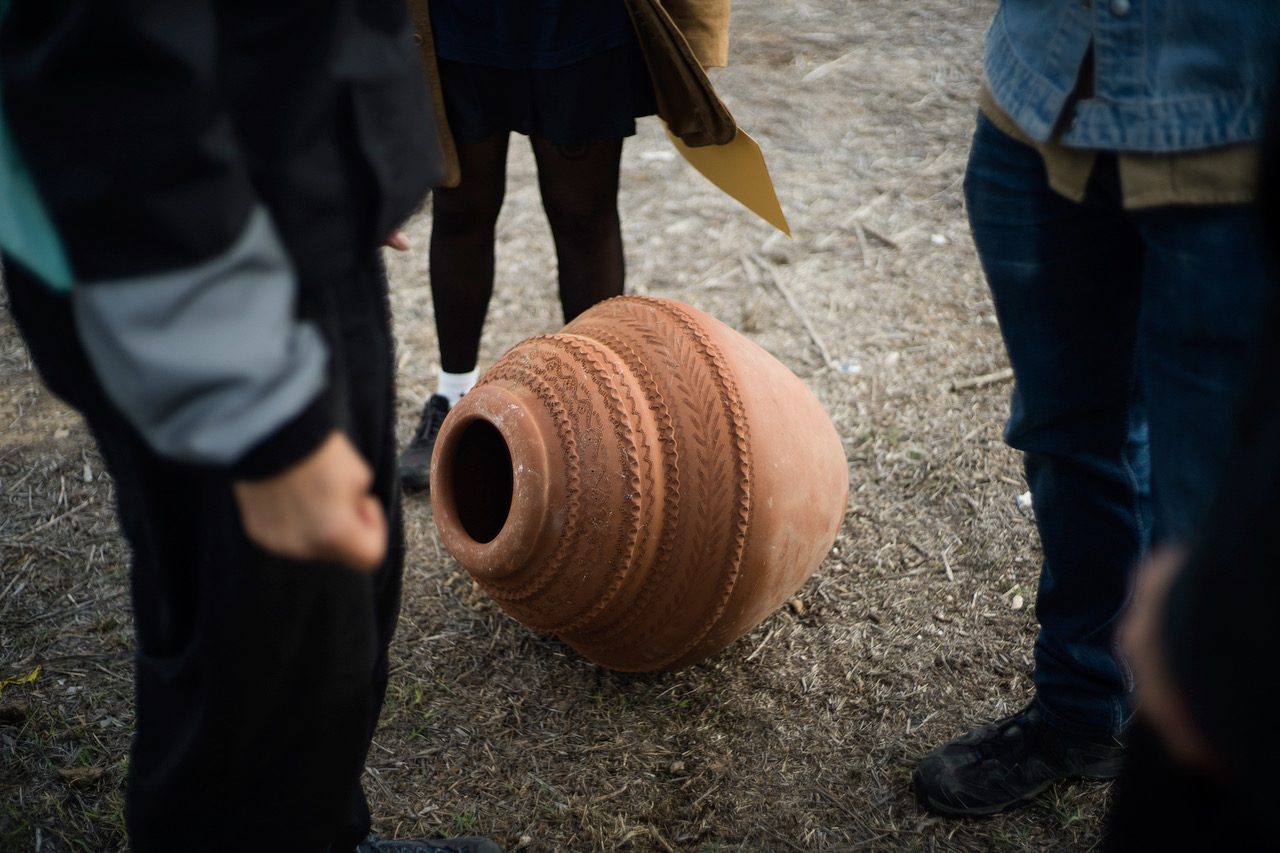
Natascha Sadr Haghighian, Marina Christodoulidou, and Peter Eramian, The Broken Pitcher, 2022, 68′.


Natascha Sadr Haghighian, Marina Christodoulidou, and Peter Eramian, The Broken Pitcher, 2022, 68′.


French premiere of The Broken Pitcher (2022, 68’), a film by Natascha Sadr Haghighian, Marina Christodoulidou, and Peter Eramian, followed by a conversation (in English) with Natascha Sadr Haghighian, Bani Khoshnoudi and Sylvie Fortin.
The collaborative project The Broken Pitcher by Natascha Sadr Haghighian, Marina Christodoulidou, and Peter Eramian traces the effects of financialization and austerity, by way of a concrete case: a crucial meeting at a bank, to negotiate the foreclosure of a family home in Larnaka, Cyprus in 2019. Foreclosure is one of the austerity measures that were imposed on the Cypriot government by the Troika (the EU Commission, the European Central Bank and the International Monetary Fund) after the financial crisis in 2012. The Broken Pitcher looks at the banking system and explores the potentials for citizen to change the script of their interactions with this system. Shot in a one-to-one scale model of the bank room, the film reconstructs the scene of the 2019 meeting. Inspired by Abbas Kiarostami’s film First Case – Second Case (1979, Iran), the reenactment of the bank meeting is then shown to people from various backgrounds who are asked to respond to the question: “In your opinion what should the bank employees do?” The filmed responses encompass perspectives of people from different interest groups in Cyprus and beyond, including housing rights activists in Barcelona, persons who are similarly affected by these policies in Berlin and Beirut, public figures, lawyers, economists, and artists.
Natascha Sadr Haghighian
Natascha Sadr Haghighian works as an artist and organize committed to diasporia and migratory infrastructures and collectivity. Her practice is deeply invested in collaboration, play and disobedient forms of sensing and recording. She develops installations, text, video and audio works, as well as performative interventions, building on long-term research and collaborative processes. She cofounded various collectives and coalitions, including the institute for incongruous translation together with Ashkan Sepahvand, pitcherzzz with Marian Christodoulidou, and kaf with Shahab Fotouhi and Tirdad Zolghadr.
Bani Khoshnoudi
Bani Khoshnoudi is an Iranian filmmaker and visual artist whose work explores exile, the impacts of modernity, history of migrations, as well as image and archive, the memory of antifascist struggles. She studied architecture, cinema and Italian at the University of Texas at Austin and was studio artist at the Whitney ISP program. Her films, photography and installation work have shown internationally in festivals and museums including the 60th Venice Biennale, the Centre Pompidou, MoMA, Fondation Cartier, Fundación PROA, BOZAR and Fundação de Serralves, Museo El Eco and MUAC. In 2022, she won the Herb Alpert Award for the Arts in Film/Video. Her latest film, The Vanishing Point, won Jury Prize in the Burning Lights Competition at Visions du Réel, Best Director’s Prize at Ficunam (Mexico City), the Youth Jury Prize at Filmmaker Fest (Milan), and the Grand Jury Prize at the Athens Avant-Garde Film Festival. She splits her time between Mexico and France.
Sylvie Fortin
Sylvie Fortin is an interdependent curator, researcher, writer, and editor based between Montréal, New York, and Buenos Aires and working internationally. She was Curator-in-Residence at Bemis Center for Contemporary Arts, Omaha, USA (2019–21); Executive/Artistic Director of La Biennale de Montréal (2013–17); Executive Director/Editor of ART PAPERS, Atlanta (2004–12); Curator of Contemporary Art at the Agnes Etherington Art Centre, Kingston, Canada (2013); and Curator of 5th Québec City Biennial, Quebec, Canada (2010). Fortin lectures widely and her critical essays and reviews have been published in numerous catalogues, anthologies, and periodicals, including Artforum International, ART PAPERS, Art Press, Art Review, C Magazine, e-flux Criticism, and Frieze.
This public programme is part of Sylvie Fortin’s curatorial research residency at Bétonsalon.
Thanks to the Canada Council for the Arts for its support.

